
Essay by Amy Stewart
It takes a courageous maker indeed to relinquish control of the pointy, commercial end of their practice to the discretion of the public. Fran Allison is that kind of maker, and she devised Change/Exchange as an experiment in three phases. Billed as ‘a
limited run recycling service’, the project was an articulate gesture that hid an equally articulate examination of capitalism, waste, and above all, value.
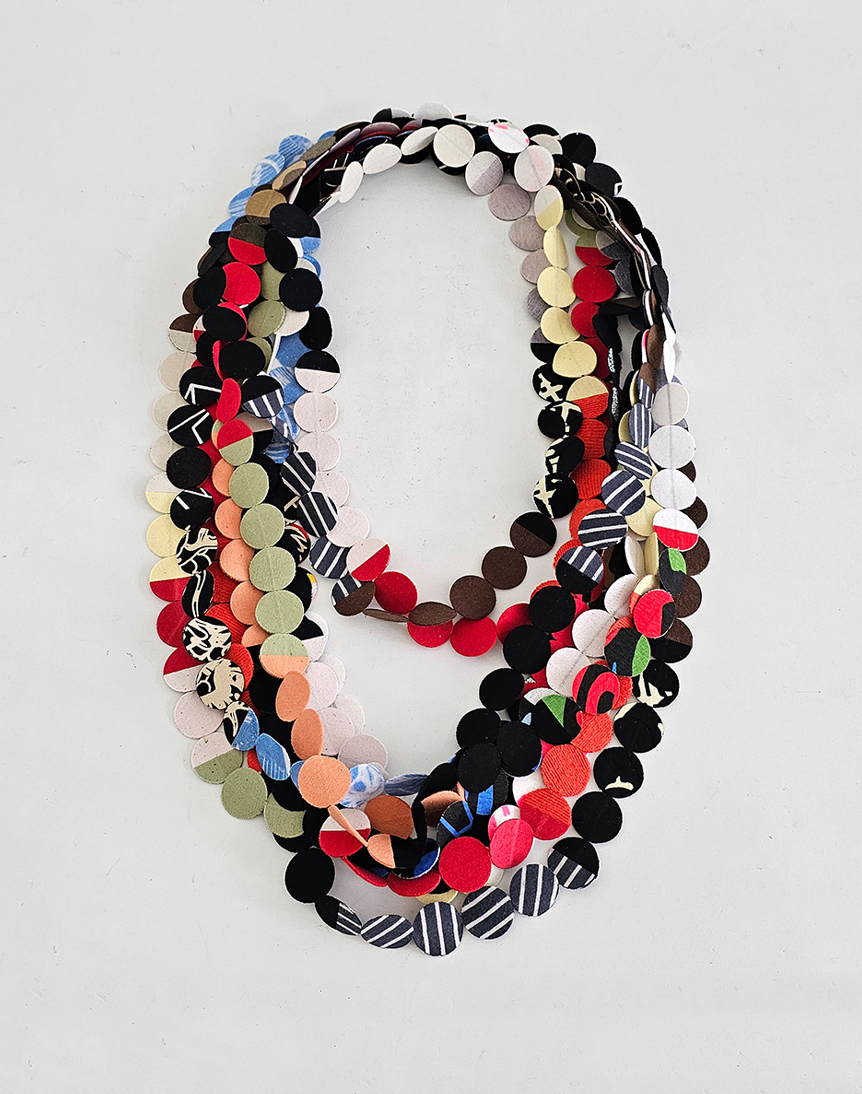
First Allison asked people to give her old t-shirts, inevitably laden with invisible, deeply personal history. She accepted 25 shirts and subjected each to a ‘transformational exercise’, transfiguring them into a fran_co original, a necklace of flat, fluttering ‘shadow beads’. Next she exhibited the necklaces and asked for koha in exchange for the service. The invisible part – the making, the labour – is where it gets interesting. In his book Debt: The first 5,000 years, anthropologist David Graeber cites the economist-anthropologist Philipe Rospabé’s research on ‘bride-price’: the exchange between families of ‘primitive money’ –cowrie shells, a whale tooth, oxen – for women. Rospabé’s view is that the money must be considered a gesture rather than a payment: ‘The whale tooth, however valuable, is not a form of payment. It is really an acknowledgement that one is asking for something so uniquely valuable that payment of any sort would be impossible.’ 1 In this way, Rospabé says, money is ‘a
substitute for human life.’ 2
Making takes time. Learning an art takes time. Honing a personal style, a method, a practice, takes a life-time. What Allison offered each participant was nothing less than an irrecoverable segment of her life, equal to the amount of time that it took her to extract a necklace from each shirt. Time and hard-won skill is, after all, the stuff from which every handmade thing is made. And the time each necklace demanded was significant: ‘The labour in making it was stupid,’ Allison says, ‘but really I was researching.’ The koha element also inspired some anxiety. ‘Inviting people in is slightly terrifying,’ she admits. ‘What will they think it’s worth?’ Allison knew many of the participants but some had walked in off the street. What she received in exchange varied hugely: artworks, a hand-knitted jumper, and highly inconsistent sums of cold, hard cash. Allison spent additional time
reassuring participants who didn’t know what to give, and she observed with interest that ‘the people who got particularly anxious about it weren’t makers’.
So what did the research conclude? ‘It made me realise how disjointed we’d become in the exchange of goods.’ Change/Exchange references older commerce, where you exchanged things you had for things you wanted. Allison hoped that the project would incentivise people to recycle, though she acknowledged that the hard-to-shake hierarchy of materials means that ‘jewellery made out of fabric isn’t something that most people are prepared to entertain’. Though not made of gold or precious stones, the necklaces’ medium – old t-shirts – were precious to their owners. Over time, the old, worn t-shirts had accrued value measured in stories and sentiment, value that perseveres privately even as the faded slogans emblazoned across the shirts were scrambled by their transformation into jewellery. ‘Jewellery does have a history of speech and legibility,’ Allison says. ‘The necklace is a container for a memory that only the person knows, that no one else can see.’ That private, invisible value is – like the value of Allison’s time – incalculable. The third and final phase is Value added (30 hours), an amalgam of the left over t-shirt scraps that Allison kept with permission from the participants. The beads follow the order she received the shirts, relinquishing any control she might desire over the order of colours. The pattern repeats three times for the three phases of the project. A liminal, two-toned disc joins the bead-neighbours like a handshake.
Change/Exchange is ultimately about human relationships; the neighbours grow closer as the usable textile residue dwindles: the first round has approximately five beads per shirt, the next has four, then three. Like an abacus, the beads are a ledger, a log-book.
Reflected in the title, the price is the bottom line: the actual cost of Allison’s labour calculated at the going hourly rate.
May 2024
1 David Graeber, Debt: the first 5,000 years, New York, Melville House Publishing, p131–132.
2 Ibid, p133.
